
THE LANGLANDS FAMILY
(This article is in six sections, each of which ends with a clickable link to its neighbours.)
Part 1a: Introduction
(Followed below by Part 1b: 1st generation – John, 1755-1814)
For much of the nineteenth and twentieth centuries, the Langlands name was well-known in Epsom. Members of the family were – over five generations – Builders, Property Owners, Auctioneers and Estate Agents, Clerks of the Course, Church Warden, Councillors and Chairman of the Sports Committee. Yet, today, the family has been generally forgotten.
Apart from various memorial inscriptions (as detailed in Part 6), the name is now probably known only from “Langlands Rise”, developed off West Hill, Epsom in the 1960s – and few today are likely to be aware of the connection. (Staff and pupils at Kingswood House School may also be aware that its 1973 extension is referred to as the “Langlands building” – of which more in Part 4.)
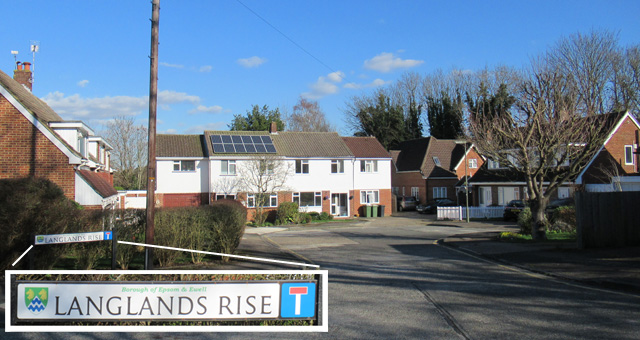
Langlands Rise, Epsom.
Photograph by Roger Morgan © 2021
Before getting into the family history, some orientation may be useful – as in the following map.

Extract from the 1936 Ordnance Survey Map
in which the numbered items are as below.
1 is the now lost Hazon House, a key Langlands’ residence;
2 is the present-day Langlands Close, doubtless named for its proximity to the site of Hazon House;
3 is the 1930s Horsley Close, the first stage of development to the immediate north of the station;
4 marks part of the subsequent Hazon Way – presumably named to reflect the Langlands’ involvement in its development.
 The now-lost Hazon House, 16 West Hill, Epsom.
Above is a photograph of Hazon House, looking across Clayhill Green in the direction of the green arrow in the map further above. Below is the same view today, showing the apartments built in the post-war Hunters Close (named, incidentally, after the Revd Archer Hunter, Vicar of Christ Church Epsom Common from 1881 to 1911.)

Modern townhouses on the site of Hazon House.
Photograph by Roger Morgan © 2021
(As an aside, “Hazon” is the Hebrew word for “vision”, with the sense of spiritual revelation rather than sight. There is a Mount Hazon in northern Israel.)
NOTE: We shall be following five generations of the family, in each case concentrating on the one or two who are the most relevant in carrying the narrative forward.
Part 1b: 1st generation (John, 1755-1814)
The Langlands came to Epsom in the late 1700s. The first was John Langlands who was buried in the churchyard of Epsom’s St Martin of Tours in March 1814. His then age of 59, gives us a birth year of 1755, from which it seems certain that he was the son of a William Langlands and was baptised on 9 July 1755 in Forteviot, Perthshire, Scotland. We also know that his wife was named Sarah, so it seems equally certain that he was also the John Langlands who, on 4 August 1782, married Sarah Parish in the parish church of St Marylebone, London.
At some point, John and Sarah made their home in Epsom. St Martin’s records note the baptism of their two children:
- John on 12 August 1794 – who died aged just 4 and was buried in St Martin’s churchyard on 25 January 1799; and
- Lawrence (our focus for the next generation) on 1 January 1797.
John senior died in 1814 and the widowed Sarah in 1834: both were buried in St Martin’s churchyard on, respectively, 13 March 1814 and 10 June 1834.
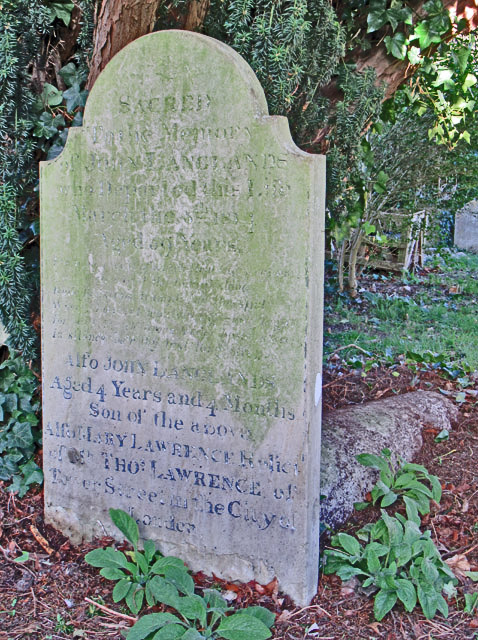
The grave of John Langlands (1755-1814) and others in St Martin’s Churchyard.
(For fuller details of this and other Langlands memorials, see Part 6.)
Photograph by Roger Morgan © 2021
Roger Morgan © 2022
with special thanks to Terry Friday for his research from which this series of articles has been developed.