
Select Illustrated Topography of Thirty Miles Round London;
By William Edward Trotter 1839
The following extract is taken from :
Select illustrated topography of thirty miles round London; comprising views of various places within this circuit, engraved … after original drawings of Charles Marshall, J. W. Allen, G. B. Campion,
 The Watch House, Epsom High Street
EPSOM
To venture upon a description of Epsom may probably appear a work of supererogation; for who among the world of London belles and beaux has not made the annual excursion to its races, or, having neglected to pay this essential tribute to fashion, would dare avow his ignorance of the place ? But as we assuredly expect to have the honour of an entree to drawing-rooms and boudoirs far distant from the metropolis, we may be pardoned for having devoted a portion of this our first number to the amusement, and we hope instruction, of our provincial friends.
Epsom, then, is a handsome, brick-built, populous village, in the eastern district of the hundred of Copthorne, western division of the county of Surrey, and distant fourteen miles and a half S.W. by S. from Westminster-bridge, on the turnpike road to Leatherhead, Dorking, Worthing, &c. It is delightfully situated on a gentle declivity at the western verge of Banstead-downs, whence the eye stretches over a magnificent prospect, embracing London, the two royal palaces of Windsor and Hampton-court, several considerable towns, and an infinite number of country seats; while in the foreground lies Epsom, picturesquely imbowered in the luxuriant foliage of several beautiful plantations. The spot it occupies was formerly designated Flower-dale, in consequence of its mild salubrious air.
Tradition derives the name from the Saxon compound Ebbshame, signifying the home or place of Ebba, who, according to Camden, was the daughter of Ethelfred, and was canonized for her sanctity. In Doomsday-book the name is written Evesham, and in subsequent records Ebbisham, from which latter word would readily spring the present appellation of Epsom. Tolond fixes the residence of Ebba at Epsom-court, which there can be little doubt was an ancient Saxon seat, and, in a less remote period, the manor-house of Epsom ; but all traces of its former grandeur have disappeared, and it now only ranks as a respectable farm-house.
The parish comprises the ancient manors of Ebbisham, Horton, and Brettgrave or Bruttegrave, the latter of which has been long extinct. The manor of Horton appears formerly to have been a distinct parish, containing a populous village of considerable antiquity, with a church or chapel situated on Stamford-green, of which no vestige remains. At the period of the Conquest, and until the commencement of the sixteenth century, these manors belonged to the mitred abbey of Chertsey, which is supposed to have been erected prior to the year 666.
The celebrity of Epsom as a place of fashionable resort originally emanated from its mineral spring, the knowledge of whose medicinal properties is attributed to accident. It is recorded that in the arid summer of 1618 a farmer observing a spring on the common, formed a reservoir around it for the convenience of his cattle, and their refusal to drink led to the discovery that the waters were strongly impregnated with alum. The inhabitants afterwards used them for cutaneous disorders with success, and from this circumstance they soon attained high repute. Salts were subsequently prepared from them, and although sold at the extravagant price of five shillings an ounce, the demand far exceeded the quantity that could be produced.
This spring, now designated the Old Wells, is pleasantly situated about half a mile to the north-west of the turnpike road between Epsom and Ashtead. A shed erected in 1620 by the lord of the manor for the protection of the sickly visitors, speedily gave place to a better structure; and in 1690 Mr. Parkhurst erected a handsome ball-room, seventy feet in length, with suitable ante-chambers, and planted avenues of elm-trees, extending to, and for a considerable distance beyond, the village. These trees, which greatly enhanced the beauty of the place, were removed about thirty years ago. Coeval with the above improvements, a considerable increase took place in the village. Lodging-houses were erected; taverns, reputed to be the largest in England, were established; sedan-chairs and public coaches were licensed ; and in the early portion of the eighteenth century Epsom had become the Spa of England.
Toland, who resided at Woodcote-park in the year 1711, gives the following beautiful picture of the then state of society in Epsom : “I must do our coffee-houses the justice to affirm, that in social virtue they are equalled by few and exceeded by none, though I wish they may be imitated by all. A tory does not stare and leer when a whig comes in, nor a whig look sour and whisper at the sight of a tory. These distinctions are laid by with the winter suit in London, and a gayer, easier habit worn in the country : even foreigners have no reason to complain of being ill received in this part of the island. In short, as England is the most plentiful country on earth, so no part of it is supplied with more variety of the best provisions, both within itself and the adjacent villages, than Epsom.”
And in describing the place he says, “the form of our village, as seen from the downs, is exactly semicircular, beginning with a church and ending with a palace, the Grove making, as it were, a beautiful knot in the middle. . . . When you are on the top of the downs, ’t is one of the loveliest prospects imaginable, to view in the vale below such an agreeable mixture of trees and buildings, that a stranger is at a loss to know whether it be a town in a wood, or a wood in a town.”
Shortly after the above period the waters lost their reputation, owing to the venality of an apothecary of the name of Livingstone. This man, who had amassed a considerable property by his practice in the town, purchased an estate, on which he pretended to have discovered another and more efficacious mineral spring than that already opened; and having erected a splendid assembly-room, pump-room, bowling-green, &c., opened the place under the title of the New Wells. In 1715 he obtained an assignment of the Old Wells, which he closed; and from that time the town was rapidly deserted. This assembly-room, now converted into shops, forms the right extremity of our illustration.
A temporary restoration of the gaieties of Epsom took place during the scheming mania of 1720; one of the favourite speculations of the day being to make Epsom a place of country amusement for the citizens; and for this purpose several large buildings were actually erected, and every species of profligate and vicious entertainment was introduced and prevailed in the village. About the same time the celebrated female bone-setter, Sarah Wallin, honoured Epsom with her presence; and this eccentric being, who is reported to have rectified many extraordinary cases of malformation, was for some time the lion, or, if the reader please, lioness of the day: she eventually died in Saint Giles’s in such distress as to require a parochial funeral.
The races of Epsom formed the next object of attraction to the place. In what year these were first regularly established appears doubtful; but they can be traced periodically from 1730. The days of meeting are annually on Tuesday, Wednesday, Thursday, and Friday immediately preceding Whitsuntide; or a fortnight later if Easter occur in March. The course is on the downs adjoining the town, and is ornamented with a handsome stand. The races usually commence about one o’clock, and conclude soon after four; and the following is the order in which the principal stakes are contested. On the first day the Surrey, the Shirley, and a sweepstakes; on the second the Craven, the gold cup, and the Woodcote; on the third the Derby, the Durdans, and the Denbies; and on the fourth day the Oaks, a plate, and the Woodcote-park stakes. The fashionable race is the Derby; and the favourableness of the season, the gaiety of the equipages, the natural beauty of the surrounding scenery, heightened by the gay concourse, composed usually of several members of the royal family, the nobility and gentry of the district, and the whole rank and fashion of the metropolis, the fair sex forming a very considerable component of the aggregate mass, combine to render the scene one of the most brilliant and animated that can be conceived.
The town contains many handsome houses, with several elegant shops; and in an abundant supply of provisions ranks above most other places within the same distance from the metropolis. A weekly market, chiefly for corn, together with an ancient annual cattle fair, both of which had fallen into disuse, were renewed in 1833. The market, which was originally chartered by James the second, is now held every Wednesday; and the fair takes place on the twenty-fifth of July at a place called Clay-hill.
A branch of the West Surrey bank has been recently established here; and gas-works and a mechanics’ institute are in progress. The old clock-house and pond, which appear in the centre of our illustration, are situated about the middle of the town. The chief inns are the Coffee-house and the Spread Eagle, in the former of which the petty sessions are held. Letters are forwarded by a mail-cart to Kingston, where they join the Portsmouth mail. The delivery is at eight a.m.; and the post-office closes at ten p. m. Epsom has one regular morning coach; and several others from Worthing, Horsham, and Dorking pass through the town during the day. Some excellent private schools are established here; and at the entrance from London is a national subscription school, in which between seventy and eighty boys, and an equal number of girls, are instructed on the Madras system in all the useful branches of education.
The church, which is dedicated to Saint Martin, and the first stone of which was laid on the nineteenth of May 1820, stands at the southern extremity of Church-street. The old building, which was insufficient for the accommodation of the increased population of the place, as well as being in a ruinous state, was taken down, with the exception of the north-west tower, and on the site was raised the present edifice, which is a neat structure in the early English style of architecture, the leading features of the old building having been carefully preserved. The new portion consists of a nave, a chancel, and side aisles, attached to the original tower, which is square, and surmounted by a light elegant spire terminating in a cross and vane. This tower is built upon arches, forming the approach to the north aisle, and beneath it stands the old font. The angle formed by the east end of the south aisle, and the south side of the chancel, is occupied by the vestry. The building is of brick, strengthened with stone quoins, buttresses, and plinth, and faced with flints. The buttresses at the west front are continued above the cornice, being surmounted by octangular pinnacles terminating in finials. The interior presents a very elegant arrangement. The altar window is of stained glass, in three compartments; the centre one representing our Saviour after Leonardo da Yinci; while that to the north displays the royal arms, and that to the south the arms of the late bishop Tomline encircled by the garter, of which order he was prelate in right of his see.
The living is a vicarage, in the archdeaconry of Surrey and the diocese of Winchester. The patronage belongs to Speer, Esq., and the great tithes to the present incumbent, as lay impropriator. The vicarage house, also situated in Church-street, is an antique edifice, almost hidden from view by some fine trees.
The parish of Epsom is 3970 English statute acres in extent; and contains 542 houses, which are tenanted by 624 families, amounting to a population of 3231. It forms the head of a union comprising the fifteen parishes of Epsom, Ashtead, Banstead, the two Bookhams, Carshalton, Cheam, Cuddington, Chessington, Cobham, Ewell, Fetcham, Leatherhead, Stoke d’Abernon, and Sutton. The union-house is now in the course of erection at the south entrance of the town, on the site of the old poor-house.
Epsom and its neighbourhood can boast of having been the favoured retreat of many eminent characters; and close to the town is the old palace — or rather its substitute in the form of a handsome and spacious mansion on the same site — of Durdans, said to have been erected by lord Berkeley out of the ruins of Elizabeth’s palace of Nonsuch, and which is made the scene of some gay doings of the “ merry monarch” in Leigh Hunt’s Sir Ralph Esher. Sir Ralph’s introduction to the afterwards celebrated Nell Gwynn also took place at Epsom. Connected with this and other mansions in the locality are many interesting historical events, a few of which we must endeavour to weave into a garland for a future birth-day or wedding-day present to some of our fair readers.
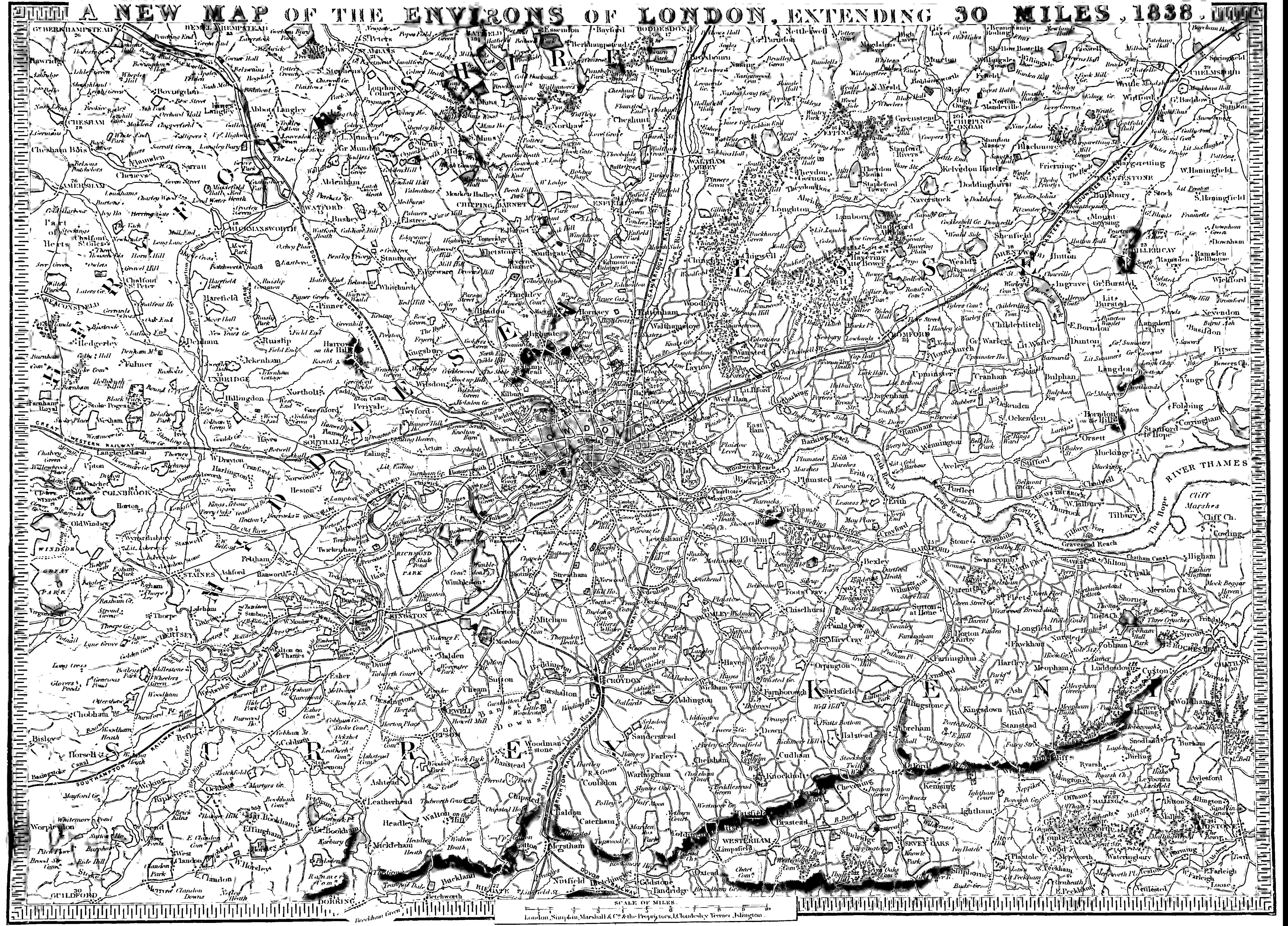 The 1838 Map of the London area which was part of Trotters book.
Click Image to enlarge