
Sir Ernest John Hutchings Lemon (1884-1954)
Railway and Aircraft Engineer

Sir Ernest John Hutchings Lemon
by Elliott & Fry bromide print
© NPG x90259 (CC BY-NC-ND 3.0)
Sir Ernest John Hutchings Lemon O.B.E. (10 December 1884 – 15 December 1954) was the Chief Mechanical Engineer of the London, Midland and Scottish Railway and later one of its three Vice-Presidents.
Ernest was born in the small village of Okeford Fitzpaine near Sturminster Newton, North Dorset. His father was Edward Lemon, a carpenter/agricultural labourer, and his mother Martha Mary Leon (neé Rose) who was laundress for the nearby Rectory. His first job was the Rectory’s ‘back door boy’ where his intelligence was spotted by the Rector. When the Rector’s daughter married Professor Martin Laurie, brother of the Principal of Heriot-Watt College, she moved to Kirkintilloch, Scotland and took Ernest with her. With Laurie’s encouragement he started an apprenticeship with the North British Locomotive Company and attended the Royal Technical College, Glasgow. Later he worked in the Edinburgh drawing office of Brown Brothers & Co and while working there he attended Heriot-Watt College to become a mechanical engineer.
In 1905 he started working in the Running Department of the Highland Railway and later in 1908 he joined Hurst Nelson at Motherwell. Ernest became Chief Wagon Inspector of the Midland Railway in England in 1911.
On 15 October 1912 Ernest married Amy, the daughter of farmer Thomas Clayton, and subsequently the couple had two sons.
Five years later in 1917 he was made Carriage Works Manager at Derby. During WW1, Ernest and his team built ambulance trains that were used to transfer some of the millions of wounded soldiers to battlefield hospitals and from there, via hospital ships, to the military hospitals in the UK. Ambulance trains would carry up to 500 casualties and over 50 staff so needed to include wards, pharmacies, emergency operating rooms, kitchens and staff accommodation. Ernest was appointed the O.B.E. for this work.
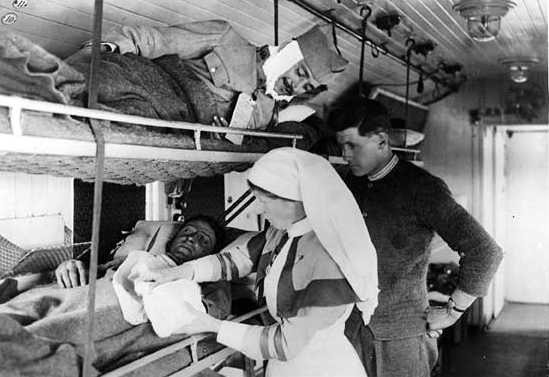 French & British WW1 soldiers being taken from the battlefront in a British ambulance train
Source not known
 Unloading war casualties destined for Horton War Hospital at Epsom Station
Image courtesy of Epsom and Ewell Local and Family History Centre
In 1923 he was appointed Divisional Carriage and Wagon Superintendent for the London, Midland and Scottish Railway (LMS). There he introduced production line methods for the construction of wagons and carriages. In 1930 he became LMS Vice President and undertook modernisation of their depots and railway operations.
In 1929 Ernest joined the Territorial Army Royal Engineers as a major in the Engineer and Railway Staff Corps and was promoted to Lieutenant-Colonel in April 1932 but he resigned his commission in August 1943 to fully concentrate on his war time role as Director-General of Aircraft Production which he had started in 1938.
His Air Ministry role resulted in fundamental improvements to the way aircraft, including the Spitfire and Hurricane, were produced. He received a knighthood in the 1941 New Year’s Honours list for this work.
Ernest died on 15 December 1954 at Woodcote Grove, Chalk Lane, Epsom. Probate value £14,266 10s 3d
Peter Reed 2021