
George Bennie (1892 -1957)
Inventor / Pioneer and a patient in St Ebbas Hospital
 The Meccano Magazine August 1930
Very little is known about George Bennie’s personal life. We know he was born on 29 August 1892 in Pollokshaws near Glasgow where he was brought up. He was the second of four children of John Bennie, the co-owner of an engineering company the Star Engine Works, and his second wife, Elizabeth Gillespie. His father’s first marriage was to Elizabeth Fisher and they had 8 children.
1914 found 22 year old George in the Army Service Corp as a Private with service number RTS/3794 in the Remount Section and went to France on 20 August 1914. This date indicates that he was a regular and would have been an ‘Old Contemptible’ and he was awarded the 1914 Star. While in France the Remount Section, which was responsible for the purchase and training of horses and mules, moved several times and comprised a main depot with around 2600 animals and two advanced depots each with around 300 animals. Later in the war George transferred to the Royal Flying Corps (RFC) as an Air Mechanic on 5 March 1916 with service number 26321. When in April 1918 the RFC became the Royal Air Force he was classified as a Fitter (Aero Engines).
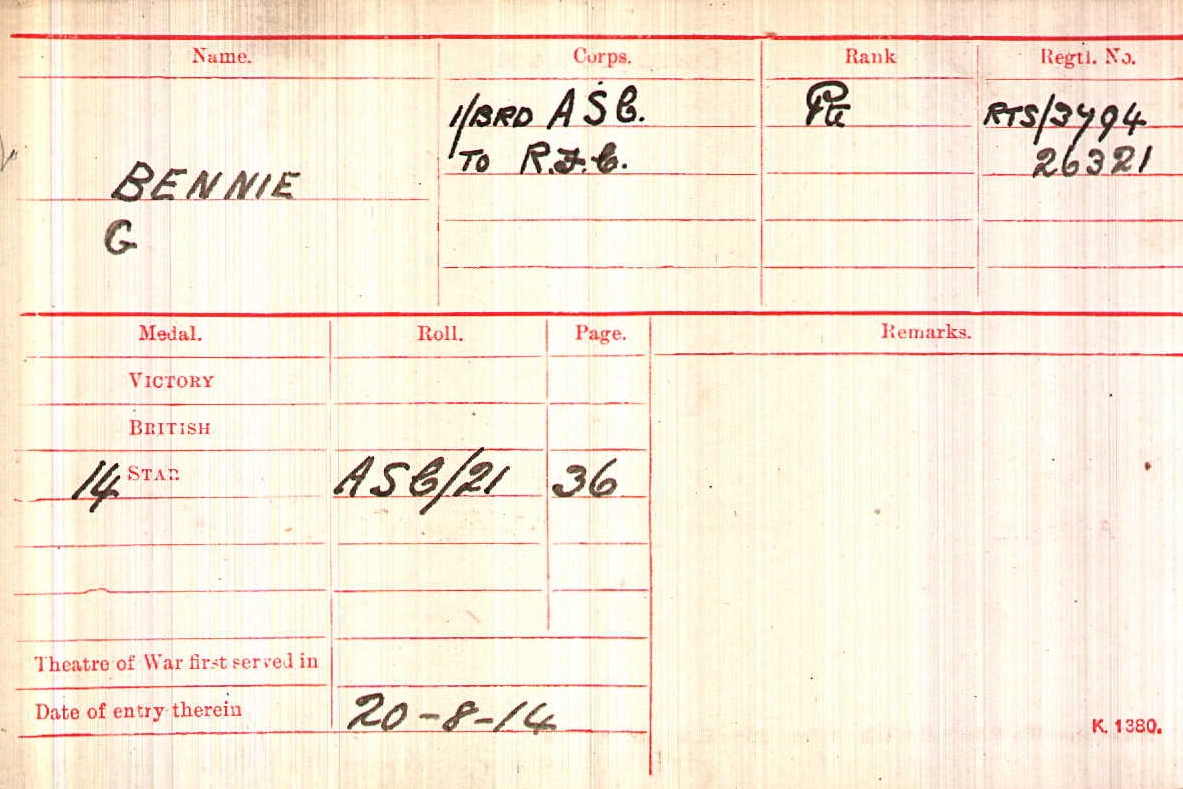 George Bennie’s Medal Card
Image courtesy of Ancestry.co.uk (Link opens in a new window)
Copyright 2010, The Generations Network, Inc. Reprinted with permission. All rights reserved.

He obviously was interested in transport systems, as in 1921 he applied for a patent for his ‘Railplane’ system. The problem Bennie’s system was intended to solve was that passenger trains were often held up by much slower and frequently stopping goods trains. His aim was to provide rapid transport for passengers, mail and other light non-bulky freight by means of a propeller-driven coach suspended from a mono rail.


 George Bennie (first left) showing a model of his proposed system c.1928
Source not known
The patent was granted in 1923 and by 1930 a short 426 feet (130m) prototype track was installed over a disused LNER siding to Burnbrae Dyeworks at Milngavie, near Glasgow.
 Extract from an OS Map showing the location of the overhead track
 George Bennie Railplane test track, Milngavie,
New Kilpatrick, Dunbartonshire, Scotland, 1930
The elevated track would be gantry mounted over the conventional rail tracks. The gantries would only need small concrete pads so that hardly any extra land need be bought. By following the existing track his system would share the overheads of existing stations and other infrastructure.
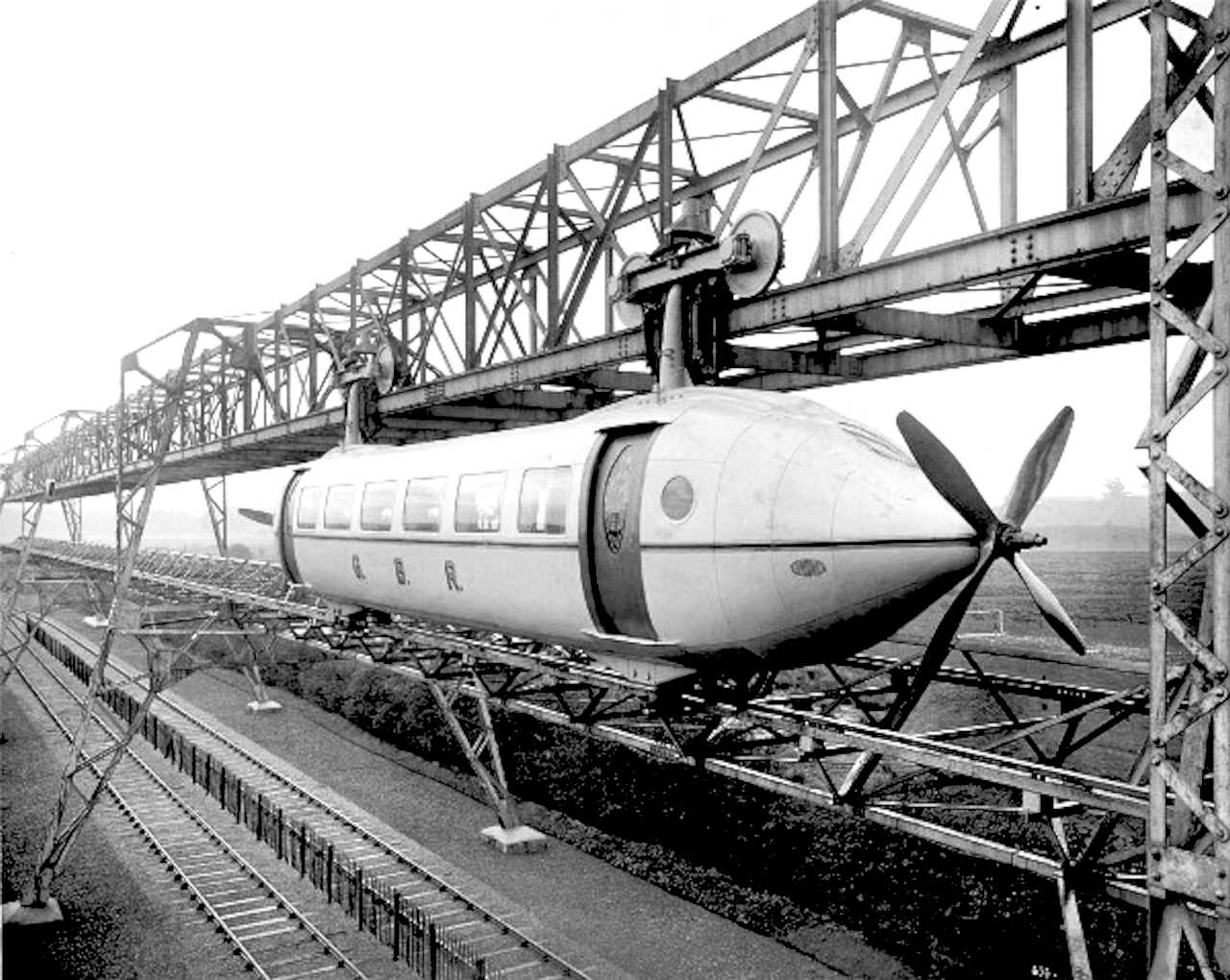 The prototype Railplane over the LNER line at Milngavie
Source not known
The aerodynamic Railplane would in theory reach speeds in excess of 200kmph (125mph), powered by electrical or petrol-driven propellers. Bennies initial design included large air foils on the carriage roof to increase lift and reduce friction but this idea was dropped in favour of slight bumps were the bogies were attached to the carriage.
The carriages would climb much steeper inclines than surface trains, so reducing the need for cuttings and embankments; also the need for banking on curves was eliminated, as the carriages were stabilised by a lower rail. The bogie wheels had rubber inserts to reduce noise and vibrations etc and, as they were not being used to drive the train, there was much less friction.
 The Railplane over a surface goods train
Source not known
The prototype train looked much like an airship gondola and had a luxurious interior with Waring and Gillows armchairs; the entry door had a stained glass Rennie Mackintosh-style window.
 Interior view of the Railplane
Source not known
The prototype system was very well received but came at the start of the 1930s depression and Bennie failed to attract the financial backing he needed to develop it. By early 1937 Bennie had sold his interest in the development company and he was declared bankrupt with unsecured debts of just over £5,000 and more than £22,000 contingent liabilities. Experiments on the Railplane prototype system continued for a short while without Bennie’s management but it was never developed to the point of carrying fee paying passengers. Eventually the prototype system was abandoned and lay rusting in a field before being sold for scrap in 1956.
Bennie continued to work on other ideas for railplane systems but he seems to have been living in reduced circumstances, as the 1939 register shows he was living in some form of lodgings/shared household in Ebury St, London SW1. Following the failure of any of his Railplane proposals to become completed projects, Bennie is said to have opened a herbalist shop. We know Bennie was a keen golfer and liked sailing, and believe he was unmarried. He died on 19 November 1957 and, according to an Ancestry Family Tree, this occurred at St Ebba’s Hospital Epsom.
 An artists impression of what a Railplane line would look like running along a Oxford Street, London
The original shed where the Railplane carriage was built in Main Street, Milngavie is now occupied by a timber merchant, and has a blue commemorative plaque on the outside wall.
 Blue Plaque commemorating George Bennie
Photographed by Richard Sutcliffe in 2018 via Wikimedia
Other propeller prototypes
Using a propeller to drive a train was not original, as near contemporary examples were built in Germany and in Russia, but Bennie’s concept was for a complete rail solution, not just rolling stock. It dealt with many of the issues a new rail line would face and could be brought into operation at considerably less cost than a surface system.
 The German Dringos engine c1919 designed by Otto Steinitz (3rd left)
Source: Die Wochenschau, 17 January 1920
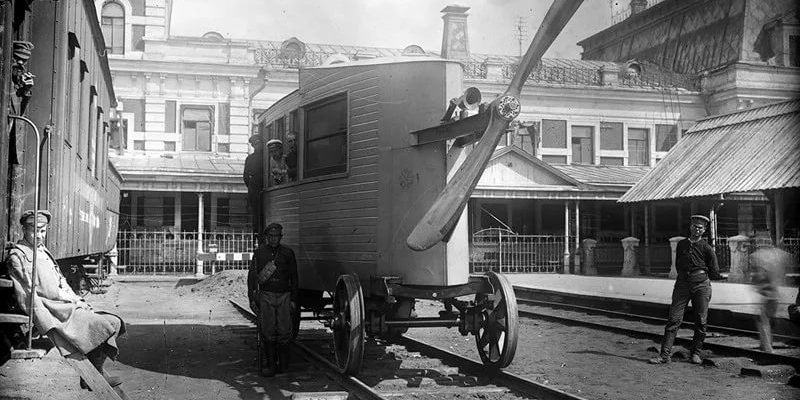 The Russian Abakovsky Aerowagon designed by Valerian Ivanovich Abakovsky c.1921
 A 1929 Rail Zeppelin (Schienenzeppelin) designed by Franz Friedrich Kruckenberg
Peter Reed 2021