
ELIZABETH WELCHMAN (1829-1906)
and her GARDENS
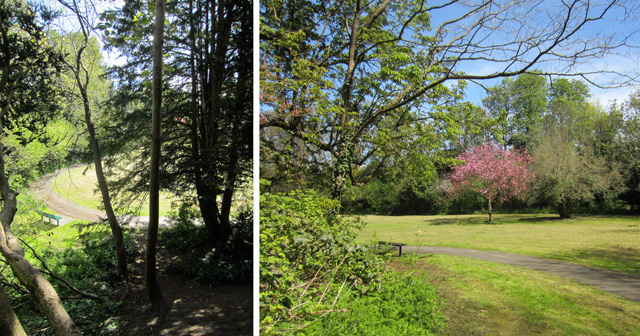
Two views of the Elizabeth Welchman Gardens.
Photographs courtesy of Bourne Hall Museum.
In Downs Road, Epsom – just before the junction with Church Street and Burgh Heath Road – is one of the Borough’s smallest parks. Created from a former chalk pit, it is named the “Elizabeth Welchman Gardens”. Who was this woman? And why are the Gardens named after her?
Elizabeth was born in Buenos Aires, Argentina in 1829 – the third of four children born to ex-patriates Peter and Mary (née Butterworth) Sheridan. Her father, Peter, had emigrated from County Cavan in what is now Northern Ireland and, from modest beginnings, made his fortune in both wool (at the time of his death in 1844, he owned 40,000 sheep on 16 stations) and meat.
On 12 November 1833 – some four years later – she and her younger brother, Henry (born on 13 September 1833) were baptised in Buenos Aires’ St Andrew’s Presbyterian City Church.
In 1834, the couple’s second child, Alfred died at the age of 5. In 1835, the mother, Mary, brought the surviving three children to England for their education. Sadly, Mary died shortly afterwards, the 39 year old’s death being registered in Liverpool. The children were left with guardians.
In due course the children returned to Argentina, where younger brother Henry became a celebrated artist – a talent he had developed in England. (The 1851 census found this 17 year old living as a “pupil” in the household of Thomas Banner, a curate in Lancashire. In 1857, while he lived in Whitehaven, in Cumberland, he exhibited a painting called The Fall of the Aar at Handek at the Royal Academy – this Swiss waterfall suggesting that he had travelled in Europe.)
To revert to Elizabeth, the subject of this article, she – now aged 33 – married the 40 year old William Whateley Welchman in Buenos Aires’ St John’s Anglican Church on 2 August 1862.
William had been born in early 1822 in the village of Wappenbury in Warwickshire, about five miles north east of Leamington Spa. He was the fifth of seven children born to Robert and Elizabeth (née Roadknight) Welchman. (Confusingly, the newly married Elizabeth – formerly Sheridan – had not only a mother in law but also a sister in law named, like her, “Elizabeth Welchman”!)
It is not clear from the records when or why William had gone out to Argentina. Nor is it certain when the couple (who appear never to have had any children or, at least, none that survived) returned to England. William is found in an 1877 County Directory for Bedfordshire, and the couple were recorded in the 1881 Census – supported by four domestic servants – living in John’s Cottage in the village of Moggerhanger (aka Morghanger) about five miles east of Bedford.
The Census return does not record anything for the obviously wealthy William’s occupation. He died, aged 62, only three years later, on 22 June 1884 in his original home patch around Leamington Spa. He was buried in the graveyard of St James the Great in the hamlet of Old Milverton in a bend of the River Avon a couple of miles northwest of Leamington Spa. The subsequent probate record lists him as a “Gentleman” – and also indicates a somewhat nomadic existence, noting that he was “formerly of Bournemouth in the County of Southampton afterwards of 49 Cambridge-terrace Hyde Park in the County of Middlesex but late of Leamington in the county of Warwick”.
It is not currently known why the widowed Elizabeth chose then to settle in Epsom. By the time of the 1887 Kelly Directory, she is recorded as resident in Down Lodge, Church Street. As shown in the series of local directories, this remained her home until her death in 1906. She was, however, away (and not yet found) at the time of the 1891 Census which recorded the sole occupant of Down Lodge as 24 year old housemaid Hannah Courtnall. She may have been travelling abroad: for example, there is a record of her arriving in New York in July 1894, having sailed from Liverpool. In any event, she was back at home for the 1901 Census which records this 71 year old being supported by two domestic servants. That Census return notes that she had been born in South America, but adds “(British Subject)”.
(The 1901 Census return wrongly named the property as Down Hall. The enumerator had presumably confused Down Lodge with Down Hall in Burgh Heath Road – which is the continuation of Church Street).
Elizabeth died on 18 October 1906, aged 77, and was buried in grave A516 of Epsom Cemetery on 22 October.
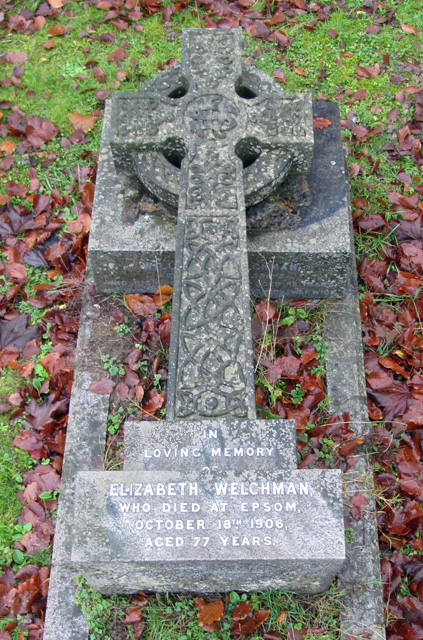
Elizabeth Welchman’s grave in Epsom Cemetery.
Photograph by Roger Morgan © 2019.
The inscription on her (now-fallen) memorial cross reads:
“In / loving memory / of / Elizabeth Welchman / who died at Epsom / October 18th 1906 / aged 77 years.”
On the base that originally supported this cross are the words:
“Also of / William W Welchman / husband of the above / who died June 22nd 1884 aged 62 years / and was interred at Old Milverton Warwick”
Elizabeth died a wealthy woman. The 1907 Probate value of her estate was £66,483, being over £10 million at 2025 prices. The very first bequest in her Will (made on 29 March 1904) concerned the old chalk pit on the other side of Downs Road (then, given its destination at the race course, called “Grand Stand Road”) from the extensive grounds of Down Lodge.

Sections of the 1896 (left) and 1913 (right) Ordnance Survey maps showing, in each,
Down Lodge (top left) and the old chalk pit to the southeast of what is now called Downs Road.
The pit was probably begun in Saxon times, when it was on an open part of the downs. The quarried chalk would have been crushed and spread on the nearby “common fields” as a soil conditioner. (There was another chalk pit a little to the north in which Pitt Place – originally, and explicitly, “Pit Place” – was built.) Later, the chalk may also have been burnt to make lime which, in addition to agricultural use, went for lime mortar as used in most of the older buildings in Epsom. Although Elizabeth acquired the freehold, the pit was leased out, and its sheltered bottom (of some 60 x 135 metres) was used for cultivation.
Elizabeth’s ownership of the pit had not come with her mid-1880s acquisition of Down Lodge. Her Will records that she had bought it on 12 May 1900 from the estate of the late Jonathan Gray. (He had been recorded in the 1891 Census as a 56 year old “Builder” living at 2 West Street, Epsom with his 57 year old wife Harriett – née Dixon, the couple had married in Kensington Q4 1855 – and five daughters aged from 17 to 25. He died at home on 31 December 1898 and was buried in grave C106A of Epsom Cemetery on 5 January 1899. The widowed Harriet died shortly afterwards and was buried with her husband on 17 July 1899.)
Elizabeth Welchman left the pit in trust for the benefit of the Parish of Epsom for the purposes of the Recreation Ground Act of 1859 (but see also the provisions of some codicils set out in the postscript to this article). She also left £500 for the maintenance and upkeep of the land which was invested until it could be used. This provision of her will became operative in 1932 on the death of the life tenant. In 1935, Epsom & Ewell Urban District formally accepted the responsibility for maintaining the land on behalf of the residents of Epsom.
However, the life tenant had sublet the pit for a period that expired in 1942, and it was only then that the Council was able to have full control. (In the meantime, pupils at the progressive Sherwood School in 6 Burgh Heath Road – the garden of which backs onto the pit – were making adventurous use of it.) There were, of course, more pressing priorities in the depths of WW2 and the post war period, during which the pit became overgrown and a tip for rubbish. It was not until 1955 that the Council made plans to open up the site while preserving the quarry’s natural setting.
The cost for preserving the trees, constructing gravel paths, demolition of the greenhouses, clearing the rubbish and providing six seats, was about £950 – funded from the legacy which, through investment, had increased to over £2,500. In September 1955, the “Elizabeth Welchman Gardens” (initially, sometimes “Park” or “Garden”) were officially opened to the public at a ceremony led by the Mayor, Cllr R L Mitchell.
In his speech, the Mayor paid tribute to the benefactress of half a century ago about whom very little was known, and regretted that it had not been possible to trace any members of her family to represent her at the ceremony. Some 65 years after the Gardens were opened – and more than a century after Elizabeth’s death – this article fills in the main gaps. Nevertheless, she remains a rather enigmatic figure.
The Gardens remain a quiet oasis with a central grass area, a hard surface path running round the perimeter and many splendid trees obscuring the chalk face of the quarry. The park is for pedestrians only and dogs are not allowed. It is an ideal spot for bird and nature watching.
Roger Morgan © 2020
PS: Some provisions of the codicils to Elizabeth Welchman’s will
Elizabeth Welchman’s “last will and testament” was made on 29 March 1904. Over the next couple of years, she added seven codicils, doubtless making her a welcome customer of her Solicitors, headed by Theodore Bell.
The first codicil was made on 24 April 1905, less than a month after the main will. It took Down Lodge and (other than specific bequests) contents out of the residuary estate and left these to her cousin Elizabeth Sheridan – already identified in the main will as one of four parties having equal shares in the residuary estate. (Miss Sheridan did not keep Down Lodge. Shortly after Elizabeth Welchman’s death in 1906, the property was sold to Samuel Willson, a “fine art dealer”, recorded in the 1911 Census as resident there together with his wife and sister in law, together with domestic servants.)
This first codicil also provided that:
“Notwithstanding the devise by my will of the chalk pit, I hereby give and devise the said pit to the said Elizabeth Sheridan for her use and enjoyment for her life and the devise in my will shall not take effect until after her death.”
and
“Whereas I have also by my will devised the chalk pit adjoining my garden upon certain trusts and I have hitherto granted permission to the family of my friend Mr Collier Jones [certain to be the widower Charles Payne Collier Jones and son Bernard, at this time living in the nearby St Martin’s Avenue, and his widowed mother and unmarried sister, living in Burgh Heath Road] to have a gate into the pit and have certain use and enjoyment of the pit and I may hereafter grant similar permission to others, now I hereby direct the trustees of my will and the future trustees of the said pit so far as may be consistent with the trusts of my will to permit Mr Collier Jones and family – and any others having permission as aforesaid – to have similar use and enjoyment of the pit as theretofore.”
The fourth codicil (dated 23 April 1906) provides
“Whereas by my will I have devised the chalk pit to the Epsom Urban Authority, now I impose the following conditions upon such devise and also on my trustees in case of such devise being refused, namely: that he said pit shall not be used for training of horses or home or hospital for horses or dogs or other animals or poultry farm or any trade or business which shall or may be a nuisance or annoyance or cause inconvenience to the owners, residents or occupiers of Down Lodge and its grounds or any house whose grounds adjoin or abut on the said chalk pit.”
On non-pit matters, the last three codicils indicate the need for help in managing things – and some indecisiveness. The fifth codicil, dated 30 April 1906 provides:
“As I am not satisfied that I have sufficiently provided for my god child Gertrude Walker and her husband Alfred Walker who have always been so kind and helpful now, in addition to the legacies by my will or any codicil to them or either of them, I give to them or the survivor of them a further legacy of £1,500 free of duty”.
Six weeks later, the sixth codicil (dated 16 June 1906) says:
“I give to my friend Alfred Walker [‘friend’ was the description of both Alfred and his wife Gertrude – Elizabeth’s god child – in the main will] the further sum of £3,000 in addition to all other legacies and gifts and it is particularly in consideration of his great kindness in undertaking the management of my business affairs.”
A month later, the seventh and final codicil (dated 16 August 1906 – two months before Elizabeth’s death on 18 October) provides:
“Whereas by a codicil dated on or about 16 June 1906 I bequeathed to Alfred Walker a legacy of £3,000, now I hereby revoke the said bequest and in lieu thereof I bequeath to him a legacy of £50 as remuneration for his services in managing my household affairs since 10 May 1906.”