
EPSOM BUSINESSES IN 1861
Introduction
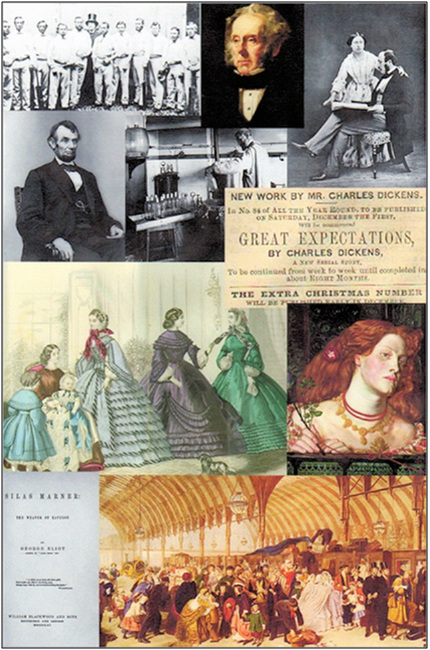 All images above are relevant to 1861 or thereabouts.
Source: Wikipedia/Wikimedia Commons.
This is a companion piece to Epsom Businesses 1911. Many of us knew relatives who had been around during the First World War era, but far fewer of us will have known anyone who had recollections from fifty years earlier. It’s interesting, looking at the 1861 establishments in Epsom, that some of the same businesses still existed in 1911, albeit that they were run by a descendant of the original proprietor. And the types of businesses had not changed greatly in the intervening half century, although I am sure that goods and techniques were different in many cases.
The project has been divided into five separate areas, please click on the links below:
Here are a few facts which will hopefully put 1861 into some kind of context:
- Queen Victoria was a year away from her Silver Jubilee and Prince Albert died in December 1861.
- The American Civil War began.
- Louis Pasteur discovered that germs cause decay in organic matter, which led to better understanding of how germs caused disease and prompted the development of various cures.
- Infant mortality was still shockingly high (but much worse in cities and industrial areas than it was in Epsom) and you will see this when you look at the families covered in this piece. Obviously, in those pre-contraception days many families had a lot of children, but you will notice that in some instances about half of them died in childhood. Now, infant mortality is around 4 deaths per thousand of births. Average life expectancy in 1860s’ towns and cities was around 40 years; by 1911 this had improved by 10 years or more and today we can expect to reach about 80 years. Tuberculosis and fevers such as cholera and smallpox had much to do with the high death rate all those years ago.
- Lord Palmerston was Prime Minister for the second time.
- A Captain in the Royal Navy issued the first public weather forecast, which led to the foundation of the Met Office (possibly a mixed blessing).
- The first England cricket tour to Australia took place and six of the squad were Surrey men.
- 12-1 shot Kettledrum won the Epsom Derby when the favourite conveniently (for Kettledrum) injured a leg in the final furlong.
- Patenting of the telephone was still 15 years away.
- Opening of the first London underground railway line (the Metropolitan) was still two years ahead.
- The motor car didn’t come along until the late 1880s, which accounts for the significant number of ostlers, coachmen, grooms, harness makers and farriers in 1861.
- Electric lighting had been invented but the first incandescent light bulbs (looking like those we had before the EU banned them) were more than a decade away.
- Although gas street lighting had been available for a long time, only the very well-to-do would have had a domestic gas supply in 1861; the Houses of Parliament installed gas lighting in 1859 and this was the trigger for gas lighting in the home (via a naked flame – gas mantles as some of us remember them were not introduced until the 1890s). The vast majority of people were still using candles and oil lamps in 1861. Epsom’s candles would have been supplied largely by the Dearle family, who manufactured them for around a century.
- Large department stores were nearly here. Derry & Toms, Barkers and Gamages all began in the 1860s/70s era. Charles Henry Harrod had been in business since 1824, as a draper and then a grocer too, and in 1851 he opened a small shop on the present site in Knightsbridge; the rest is history, as they say. He was a pioneer – Mr Selfridge did not get going until 1909.
- Newspapers became more widely affordable by the public when paper duty was abolished in 1861.
- The tune which became Elvis Presley’s ‘Love me Tender’ (1956) was originally composed in 1861 by George R Poulton as a song called ‘Aura Lee’.
Here’s a brief description of what we might have been wearing back then: gents’ attire was reasonably comfortable and, for example, could consist of frock-coat (wide lapels), waistcoat, fairly wide trousers and elaborate neckwear, but ladies had the misfortune to be incarcerated in laced corsets, hoops and crinolines. No one who was anybody at all forayed from the house without a hat and proper frock/suit and this explains why there were so many dressmakers, milliners and hatters in the town. Laundresses were ubiquitous too, although I am not sure that the more elaborate outer garments could have been kept too clean. Try washing one of the dresses below.
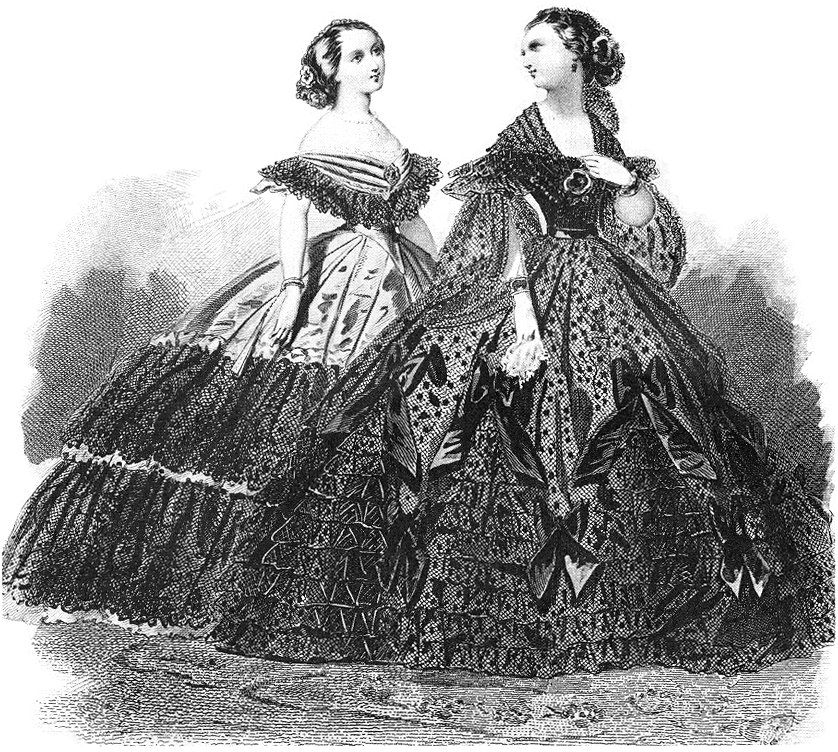
Ladies’ gowns in the 1860s.
Image source: Wikipedia.
1861 Epsom also had more bootmakers/shoemakers than you would believe necessary/possible, but everyone needed footwear and in those days one man obviously did not turn out very many pairs in a day. However, it was around this time that there were major advances in shoe-making machinery, which enabled mass production, and not long afterwards firms such as Freeman, Hardy & Willis were founded
And the Epsom bobbies looked like this.
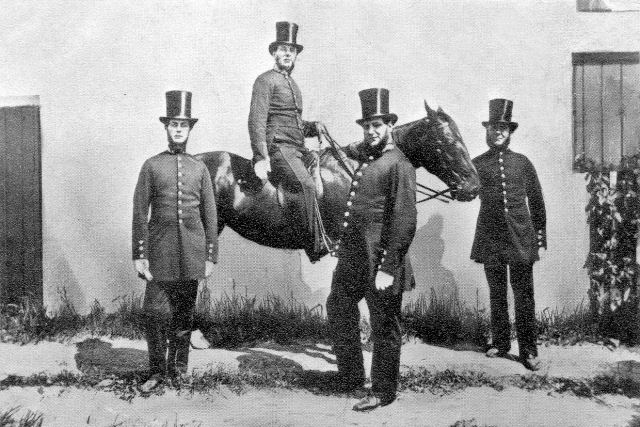 Epsom Police in the 1860s.
Image courtesy of Epsom & Ewell Local And Family History Centre
The quality of your food and drink naturally depended on what you could afford. Tea had become affordable, so that it was drunk by all levels of society, where it had once been an upper-class luxury, kept under lock and key as a precaution against thieving servants. Gordon’s Gin had already been on sale for nearly a century (Schweppes Tonic, incidentally, is the oldest commercially-produced soft drink in the world and has been around since 1771), Colman’s mustard had been on the market for almost fifty years, Wright’s Coal Tar Soap was created in 1860 and in 1862 you would have been able to buy sweets manufactured by Rowntree’s. (I mention these products particularly because, surprisingly, they are still going strong 150 years later and I have all of them in the house now.)
Here are two typically labour-intensive recipes of the time from Epsom’s one and only celebrity chef, Mrs Isabella Beeton. Her ‘Book of Household Management’ was first published in book form in the very year of 1861 (having previously been a part-work) – she was living in Harrow at the time. I show the recipes merely to illustrate what you should have been able to buy from the local shopkeepers featured in this piece if they had been doing their homework on what the ladies of Epsom were cooking!
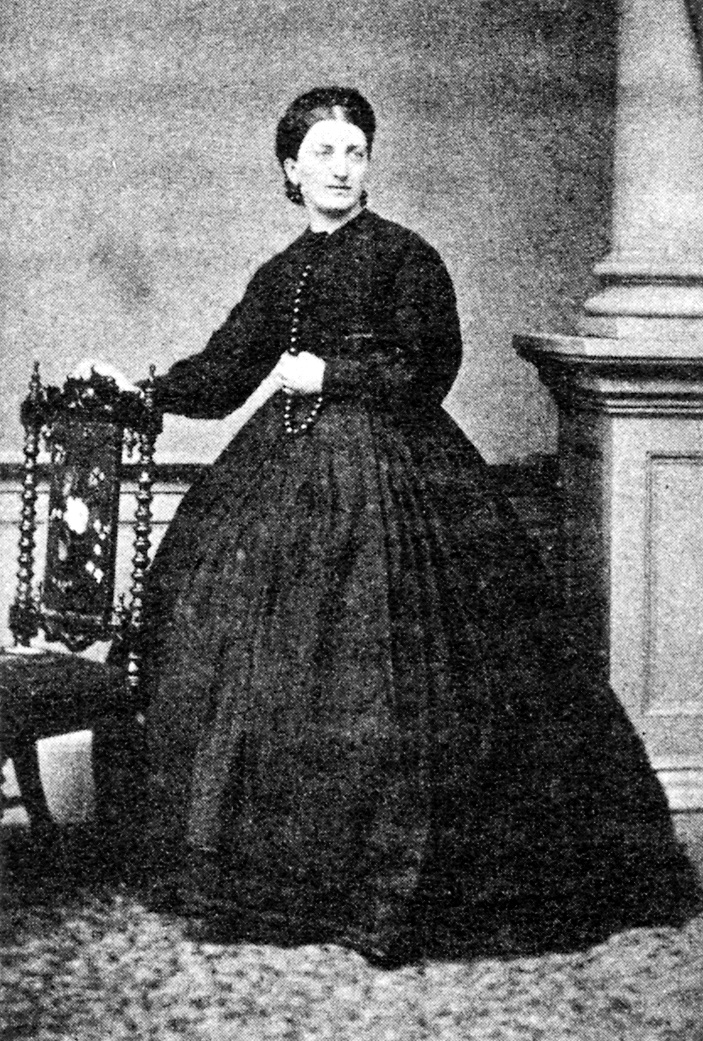 Mrs Beeton in 1860. Image source: Wikimedia Commons.
EELS A LA TARTARE
INGREDIENTS.—2 lbs. of eels, 1 carrot, 1 onion, a little flour, 1 glass of sherry; salt, pepper, and nutmeg to taste; bread crumbs, 1 egg, 2 tablespoonfuls of vinegar.
Mode.—Rub the butter on the bottom of the stewpan; cut up the carrot and onion, and stir them over the fire for 5 minutes; dredge in a little flour, add the wine and seasoning, and boil for 1/2 an hour. Skin and wash the eels, cut them into pieces, put them to the other ingredients, and simmer till tender. When they are done, take them out, let them get cold, cover them with egg and bread crumbs, and fry them of a nice brown. Put them on a dish, pour sauce piquante over, and serve them hot.
Time.—1-1/2 hour. Average cost, 1s. 8d., exclusive of the sauce piquante.
Seasonable from August to March.
Sufficient for 5 or 6 persons.
RICH STRONG STOCK
INGREDIENTS.—4 lbs. of shin of beef, 4 lbs. of knuckle of veal, 3/4 lb. Of good lean ham; any poultry trimmings; 3 small onions, 3 small carrots, 3 turnips (the latter should be omitted in summer, lest they ferment), 1 of celery, a few chopped mushrooms, when obtainable; 1 tomato, a bunch of savoury herbs, not forgetting parsley; 1-1/2 oz. of salt, 12 white peppercorns, 6 cloves, 3 small blades of mace, 4 quarts of water.
Mode.—Line a delicately clean stewpan with the ham cut in thin broad slices, carefully trimming off all its rusty fat; cut up the beef and veal in pieces about 3 inches square, and lay them on the ham; set it on the stove, and draw it down, and stir frequently. When the meat is equally browned, put in the beef and veal bones, the poultry trimmings, and pour in the cold water. Skim well, and occasionally add a little cold water, to stop its boiling, until it becomes quite clear; then put in all the other ingredients, and simmer very slowly for 5 hours. Do not let it come to a brisk boil, that the stock be not wasted, and that its colour may be preserved. Strain through a very fine hair sieve, or tammy*, and it will be fit for use.
Time.—5 hours.
Average cost, 1s. 3d. per quart.
*another kind of sieve, which looks much like a garden sieve but with finer mesh.
And before you ask why on earth she didn’t just buy a packet of Oxo cubes, the answer is that they did not go on sale until 1910, although I think that even in 1861 there must have been an easier way of making decent stock than the above.
So, now that you have a little flavour of life in 1861, please feel free to delve into the people who oiled the wheels.
Researched and written by Linda Jackson ©2014