
Back to our main war memorials page
War Memorials – Epsom Brotherhood
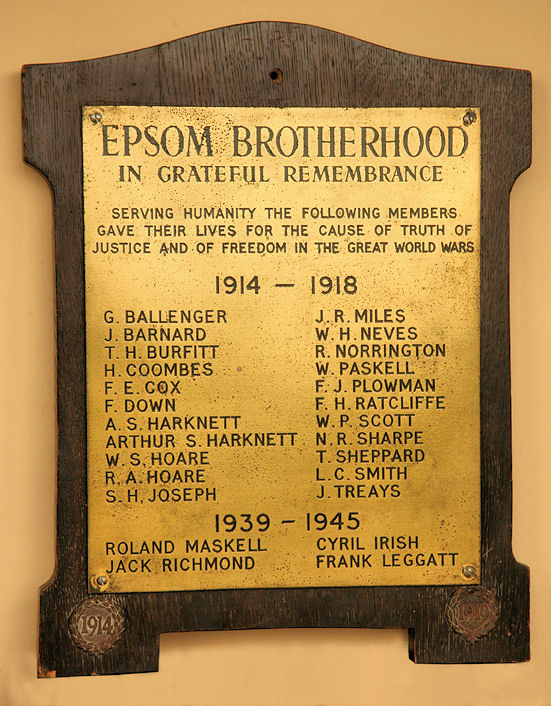
Epsom Brotherhood War Memorial
To read more about an individual please click on their name.
Photograph courtesy of Clive Gilbert © 2009
The Epsom Brotherhood was founded by the Rev Henry Atkinson in 1909 as a branch of the Brotherhood movement that existed in Surrey and elsewhere in the early years of the twentieth century. The Brotherhood (established as an organisation for all males in trade), was affiliated to the Congregational Church, its remit being Christian study and the moral welfare of local townspeople.
All men “irrespective of creed, politics, or social position” were welcomed to the Brotherhood. That quote comes from page 3 of the September 1920 Watch Tower magazine (“the organ of the Epsom Brotherhood”) published monthly and containing news from other Surrey Brotherhoods, sermons, hymns and local Epsom and Ewell trade adverts.
Meetings were held on Sundays – originally at the Congregational Lecture Hall and then at the Ebbisham Hall – and included speakers (usually on a moral, Christian theme) and often a “sacred concert”, accompanied by the Brotherhood’s orchestra which regularly gave other performances.
The Brotherhood’s ethos led to the formation of a charitable arm of the organisation and, having a strong local membership, it would seem that various projects were carried out in conjunction with Epsom local authorities.
The memorial, now held in Bourne Hall Museum, originally commemorated 22 casualties of the Great War, but was later modified to include four casualties of the Second World War.
Fuller details of the Brotherhood and its now-lost Ebbisham Hall in which this memorial was displayed are in our separate article.