
WW1 (“Great War”) Memorial at Christ Church Epsom Common
Back to our main war memorials page
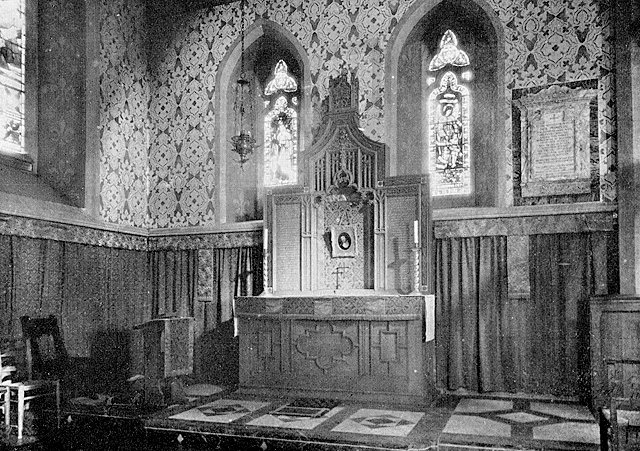 Christ Church’s Memorial Chapel in 1926
Photograph from Christ Church’s 50th Anniversary History booklet
In 1920, Christ Church Epsom Common converted its north transept into a Memorial Chapel, the earliest known photograph of which is reproduced above. (There is a modern photograph at the end of this article.) The actual WW1 memorial is the reredos immediately behind the altar, the left and right panels of which are illustrated below. (Clicking on any of the names will take you to an article about the individual.) Below that illustration are some more details about the memorial itself.
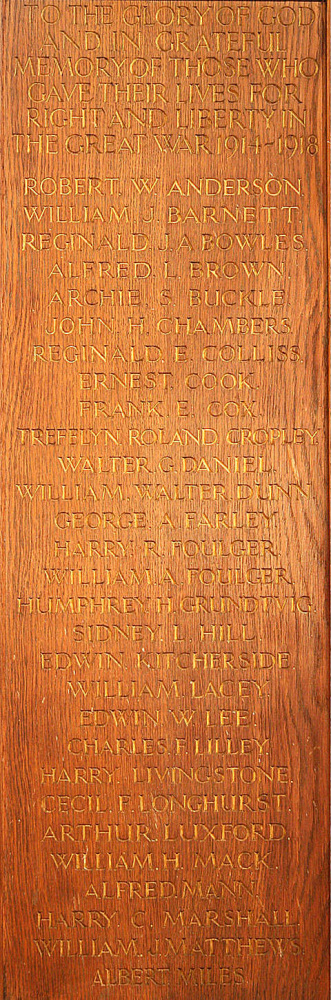
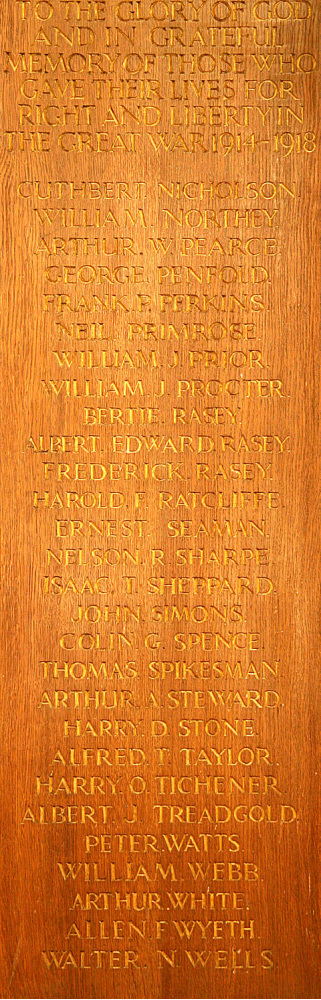
The left and right panels of Christ Church’s WW1 memorial
To read more about an individual please click on their name.
(Caution – some names are out of order.)
Photographs courtesy of Clive Gilbert © 2008
The Epsom Advertiser of 22 October 1920 printed the following account of the dedication of Christ Church’s Great War memorial on Sunday 17 October 1920. (A to I in the text refer to explanatory notes below it which expand on those particular points.):
MEMORIAL CHAPEL
DEDICATION CEREMONY AT EPSOM
In honour of the members of the parish of Christ Church, Epsom, who fell in the war a memorial was dedicated by the Bishop of Guildford after the usual evening service on Sunday. The memorial, costing £1,000 (A), is a chapel into which the north transept formerly used by the congregation when necessary has been converted (B). An altar has been erected, and in the reredos at the back are three large panels. The work has not been completed (C) but in the central panel a symbolic picture (D) is to be set, while the panel on either side will contain the names of the fallen parishioners – 57 in all (E). The whole is of oak, and above each of the outside panels is the inscription-
TO THE GLORY OF GOD
AND IN GRATEFUL
MEMORY OF THOSE WHO
GAVE THEIR LIVES FOR
RIGHT AND LIBERTY IN
THE GREAT WAR 1914-1918
As the reredos hides the stone tablet provided by Lord Rosebery in memory of the Hon. Neil Primrose the tablet is to be removed, but it has not been decided in which part of the church it will be placed (F).
There have been many memorial gifts to the chapel, including the altar, marble sanctuary flooring, reredos, panels, cross (G), candlesticks, credence table, service book, book rest, and sanctuary lamps, one being from Mr. G. Good (H), organist, in honour of members of his choir, and another from the Post Office staff as a tribute to one of their colleagues (I).
At the service special seats were reserved for relatives and ex-service men, the latter having marched to the church behind the Comrades’ band, and the congregation remained standing while Mr. Good played very impressively a requiem by Mackenzie.
The Bishop, the Vicar (the Rev. H.A. Bowles (J)), and the Rev. H.P. Metcalfe, accompanied by the churchwardens, went to the entrance of the chapel, and special prayers were said and sung, after which the Bishop entered the pulpit.
His sermon was on the meaning of the memorial, not only from the present, but the future, when the story of the gallantry and noble sacrifice of their men would be retold to the young men and maidens who would worship there. He welcomed that opportunity of taking a humble part in that tribute of respect and gratitude to the men to whom they owed so much. Their first thought must be one of praise and thanksgiving for deliverance from the war. Their country was richly blessed, but that richness was not measured by the beauty of the landscape, nor in the history of prestige or the country, but in the human character. In the hour of the nation’s gravest peril men gave themselves without stint. They came from all parts of the country, giving up everything and leaving all behind in answer to the call. To some extent they knew what was before them, but they met death oftimes with a smile on their face and a cheer on their lips. They were apt sometimes to despair of a country, but could not they ever despair of a country for which men had thought it worth while to pay such a price?
That memorial would remind them of gallantry, heroism and supreme devotion, and they must remember the men in whose honour it had been erected not as they were but as they are.
The following notes expand on various points in the above.
A. £1,000 in 1920 would be over £40,000 at today’s prices.
B. The chapel was indeed converted from the north transept. However, while the Advertiser notes that this was “formerly used by the congregation when necessary”, its more frequent use was by Lord Rosebery (a regular worshipper at Christ Church) and family who regarded the transept as their private pew.
C. The work was not complete by the time of the memorial’s unveiling. As noted, the 57 names had yet to be carved into the two panels (and, when they were, some were slightly out of the obviously intended alphabetical order). Work on the chapel itself continued for several years. In the Parish magazine for February & March 1923, the Revd Neville Stiff (Christ Church’s Vicar, who had died – of an asthma attack – just before its publication) wrote that finishing the Memorial Chapel to the architect’s design would, given other pressing needs, have been too expensive. Instead, “a scheme of hangings and rugs was devised. The hangings are now in place – blue Kirkstall brocade and blue and gold S. Hubert brocatelle … The rugs will soon be got to complete the scheme … Wanting £ 20 to £ 30 to complete in this way, a friend lent me the money, and a slow accumulation of money is intended for the re-paying.” It is these decorations that are illustrated in the 1926 photograph at the head of this article. The decorations were much simplified in the late 1940s.
D. The intended “symbolic picture” in the central panel never materialised. The illustrations at the beginning and end of this article shows two of many short-term solutions.
E. Some of the 57 had lived in the area which, in 1917, became the free-standing parish of St Barnabas. Between 1899 and 1917, the church of St Barnabas had been a “chapel of ease” established by Christ Church to cater for the growing population in north Epsom. It is an interesting measure of Epsom’s growth in the inter-war period that, while WW2 casualty rates were lower than those in WW1, the geographically smaller Christ Church parish had 58 casualties to be recorded on its WW2 memorial, one more than on the WW1 memorial.
F. Lord Rosebery’s son, Captain the Rt Hon Neil Primrose MC MP, was killed in action in Palestine on 15 November 1917, aged 34. In August 1918, Lord Rosebery had erected a stone tablet in Neil’s memory between the two small windows of the north transept (which, as noted at B. above, was effectively the family’s private pew). As the Advertiser noted, the tablet was hidden by the new reredos and was to be moved. As shown in the photograph at the head of this article, its new location was a few feet to the right on the same wall. (Neil Primrose is one of only two WW1 casualties with a personal Christ Church memorial in addition to his mention on the main memorial – see H. below.)
G. One of the many gifts noted by the Advertiser was a cross. This was made of mother of pearl and given in memory of Humphrey Gruntvig by his parents. It was lost in 1922 in what the Epsom Advertiser for 7 July 1922 called a “despicable theft”.
H. One of the other gifts was given by Christ Church’s long-standing organist & choirmaster, George Good. His choir had been somewhat depleted during the war with men away on service, and half a dozen of these never returned, being among the names commemorated on the Memorial. One of the lost choirmen was Trefelyn Cropley. He joins Neil Primrose (see F. above) as the other of Christ Church’s WW1 casualties with a personal memorial in addition to his mention on the main memorial. In Trefelyn’s case, the brass plaque was – appropriately – originally fixed to the choir stalls. When the stalls were removed during Christ Church’s 1990s “reordering”, the plaque was refixed nearby on the chancel wall.
I. The Postman was John Chambers, who was killed in action in France on 12 April 1918, aged 32.
J. The dedication of the WW1 memorial was almost the last act in the parish of the Revd Henry Bowles, who was Vicar of Christ Church from 1912 to 1920. Sadly, one of the names on the memorial was that of his son, Reginald Bowles, who had died in France on 20 July 1916 of wounds sustained in an enemy attack earlier in the day. Christ Church’s verger at the time later recalled that the death of Henry’s son “didn’t stop him coming over to Church to say Evensong and it wasn’t until the Intercessions, when he prayed for the repose of the soul of his son, that we learnt the tragic news.”
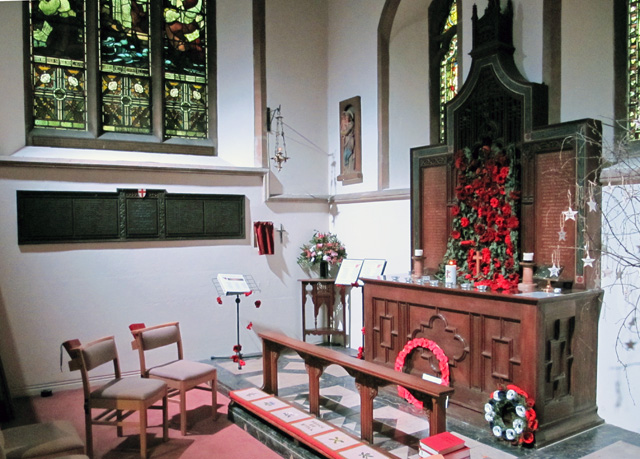 A recent photograph of what is now called the Peace & Reconciliation Chapel.
The WW1 memorial has been joined by one for WW2
(being the bronze plaque under the window).
Photograph © Roger Morgan, November 2018
Roger Morgan © 2019
NOTE: Biographies of all of Epsom & Ewell’s WW1 casualties may be accessed via the links below
A B C D E F G H I J K L M N O P Q R S T U V W X Y Z