
Epsom Municipal Baths and Hall

Epsom Baths Front
Image courtesy of Bourne Hall Museum
Background
Medical opinion during the early to mid-nineteenth century was that disease was the result of bad air. During this time, many people were living in cramped and dirty conditions thereby contributing to the condition. The Baths And Wash Houses Act of 1846 was introduced to encourage local authorities to address this issue by providing facilities for bathing and washing clothes.
The scheme was adopted by Epsom Urban District Council in 1897, but it wasn’t until 1935 that the Council decided to set up a Special Committee to investigate and report on the potential costs involved. By 1936 a full report had been provided for Municipal Baths to be built in East Street, on a site which was already owned by the Council. During the winter the hall would be used for other purposes, such as boxing matches and concerts.
The scheme submitted was approved and the Council subsequently applied to the Ministry of Health to borrow the appropriate sum. Invitations to tenders for the work were issued and ultimately awarded to Messrs. H.H. & F. Roll, Ltd of Epsom. Total cost would be £65,000 and construction started in September 1937. It was officially opened on 15 March 1939 and in its heyday during the 1950s attracted over 100,000 swimmers and spectators per year. These were monitored by a staff of 20.

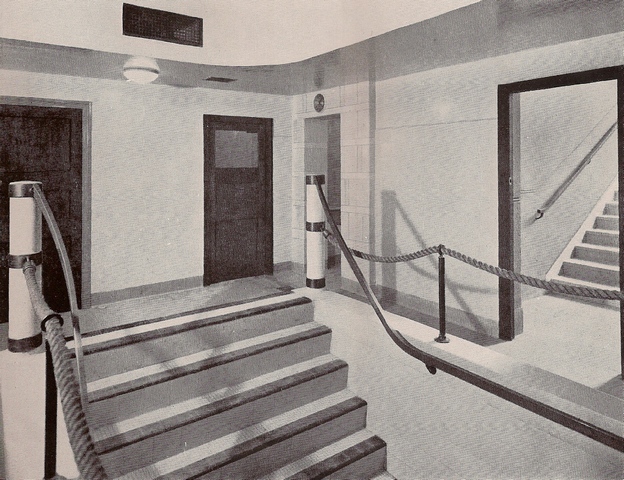
Entrance Hall
Image courtesy of Bourne Hall Museum
The Building
The front and sides consisted of multi-coloured facing bricks mixed with dark red bricks and Portland stone dressings, whilst the roof was covered with dark red pantiles. A ticket office was located in a large entrance hall, from which staircases gave access to the changing rooms, galleries, slipper baths and a Turkish Bath Suite. Two doors either side of the ticket office gave direct access to the bath hall when it was in use as a public hall. A self-contained flat was provided at the rear of the building to accommodate the Baths Superintendent. Initially a cafe was provided on the first floor, followed later by a buffet by the pool for the benefit of bathers; this was also used for wedding receptions, parties and luncheons. A laundry was provided for washing towels and linen, including that from other Corporation departments.
 The Cafe on the first floor
Image courtesy of Bourne Hall Museum
The Pool
The pool itself was 100 feet by 35 feet, with the depth varying from 3 feet at one end to 10 feet at the other. Heavy white glazed tiles lined the pool, with a surround of non-slip sand-coloured mosaic. The walls were lined with blue tiles. At the deep end was a diving stage consisting of 4 boards with the highest at 16′ 4″. Under water lighting was provided by large portholes in the side of the bath. Galleries capable of seating 412 persons were arranged along each side.

The Swimming Pool
Image courtesy of Bourne Hall Museum
A moveable maple floor on tubular scaffolding was provided to enable the hall to be converted for other uses such as boxing, meetings, dances and operatic and dramatic performances as well as bowls and indoor cricket practice. A stage was provided, with lighting, microphone and record turntable stored underneath. The hall was licensed to hold 1396 for music, dancing and meetings, and 1166 for boxing.
Dressing Rooms
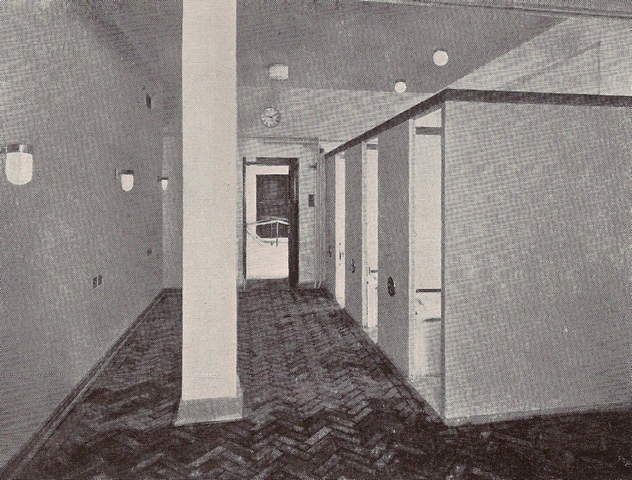
Featuring non-slip tiling, bathers would put their clothes in numbered wire baskets which were stored under the supervision of an attendant, who would issue a rubber band with the corresponding basket number. Bathers would then have to pass through a pre-cleansing shower before being able to enter the bath surround. The dressing rooms were equipped with penny-in-the-slot hair dryers and weighing machines. When the hall was used for other purposes, the dressing rooms became the cloakrooms.

Dressing Rooms
Image courtesy of Bourne Hall Museum
Slipper Baths
A Public Enquiry held by the Ministry of Health at the time showed that there were 1,500 houses without a bath within a radius of only 1 mile from the baths. With this in mind, two suites of twelve slipper baths made out of fireclay were provided on the first floor. Some people who had bathrooms at home still found it cheaper and more convenient to take a bath this way, with about 500 people still using the facilities each week in the late 1950s.
 Slipper Baths
Image courtesy of Bourne Hall Museum
The Turkish Baths Suite
The Turkish Baths Suite was mainly included for the benefit of the horse racing fraternity and was the nearest one outside London. The idea was that you would sweat off weight and leave you with a feeling of well-being. They were located in the basement and featured a changing room, vapour room, three hot tubs, shampoo and shower room, a plunge bath, foam bath and rest room. Heat was provided by gas-fired air heaters. Refreshments were available and a telephone cabinet and weighing machine provided. At its peak, around 11,000 people annually initially used not only the Turkish Baths, but also other remedial baths such as Luma and Zotofoam Baths, an early form of Jacuzzi.
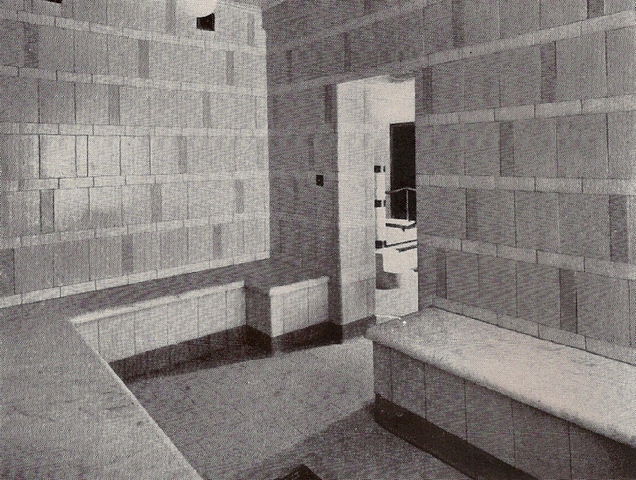
A Hot Room in the Turkish Baths suite
Image courtesy of Bourne Hall Museum
Plunge Baths in the Turkish Baths suite
Image courtesy of Bourne Hall Museum
Foam Baths
Image courtesy of Bourne Hall Museum
Water Purification
The Filter Room contained a filtration and water purification plant which was capable of turning over the bath in under four hours at a speed of 250 gallons per square foot per hour. An electrically driven centrifugal pump would send water through a cast iron strainer box to remove solid waste, whilst a valve would release a regulated dose of soda and sulphate of alumina. After filtration, the water would pass through an aerator to a calorifier (water heater) before going through a chlorine gas steriliser and then re-introduced to the bath.
The calorifier was contained in the Boiler House and was capable of raising the temperature of the water from 40 to 75 degrees Fahrenheit in 48 hours and was used to compensate for heat loss through evaporation and radiation.
Subsequent History
The Baths were closed at the outbreak of World War 2 but soon re-opened to provide dances to help morale and to give the ARP and fire watchers somewhere to sleep. Wire netting covered the windows and sand bags were used to protect the front door from blasts. Once the war had ceased, the Baths Hall became Epsom’s social focal point with dancing, boxing and many other activities regularly provided, the highlight arguably being a sold-out appearance by the Rolling Stones in 1963 (for a fee of £60) and in later years, Genesis in 1972.

Elisabeth Schwarzkopf and the Epsom Symphony Orchestra in the late 1950s
Image courtesy of Bourne Hall Museum
Michael Gould played horn in the Epsom Symphony Orchestra. He writes:
I played the horn in the Epsom Symphony Orchestra as a young man from 1968, under conductor John Gale, and Derek Lucas, who was first clarinet in the orchestra. We gave regular concerts in the Epsom Baths Hall, previously a public baths at a time when not everyone had a bath at home, then the swimming baths which converted into a concert hall in the winter. I particularly remember performing Bizet’s Carmen there. A notable horn player alongside me was Handel Knott (perspicacious parents!), then quite elderly, who owned the horn once played by horn player Aubrey Brain, father of the world-famous Dennis Brain, possibly the finest horn player who has ever lived. He was sadly killed in a car accident in his prime when he crashed his car into a tree rushing back to London overnight (asleep at the wheel?) from the Edinburgh Festival – he loved speed. I went on to play with various orchestras in Mozart’s Don Giovanni, Verdi’s Masked Ball (Un Ballo In Maschera), Gilbert and Sullivan’s Cox and Box, The Sorcerer and Trial by Jury, Menotti’s Amahl and the Night Visitors, and Kurt Weill’s Threepenny Opera among others and gave fee-paying solo performances of horn concertos by Mozart and Richard Strauss. I also played at a memorial concert for Nobel prize-winner Ernst Chain and met the Man with the Golden Flute, James Galway, probably the finest flautist ever. Also, Charles Chilton, writer of Journey Into Space, which I had listened to surreptitiously under the blankets in the dormitory at school after bedtime. Charles was also a flute player and a bit of a wit. When I told him I had an early copy of Journey into Space, he quipped “And now I suppose you want your money back!” His wife Penny played the clarinet. I did all this as an enthusiastic amateur while I got on with my proper job.
I was working at the time in the nearby Ewell Technical College, later to become NESCOT, which stood for North East Surrey College Of Technology. When suggestions were invited for the new name, one wag said that we should have been North East Surrey College of Advanced Further Education, in which case we might have been subsidised by a well-known coffee supplier!
I still live fairly local, and after living in Ewell I moved to Sutton, then Wimbledon, Colliers Wood and now Mitcham.
Michael Gould: May 2025
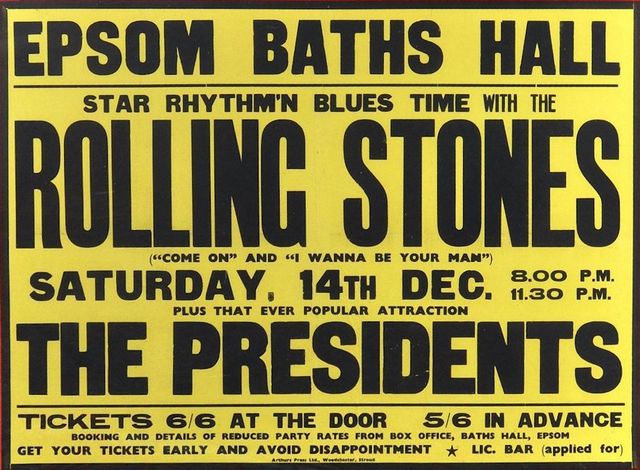
Rolling Stones, 14 December 1963
Image courtesy of Bourne Hall Museum
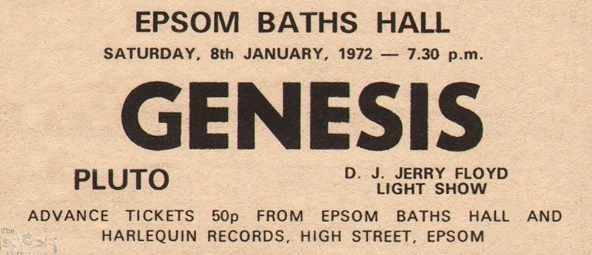
Genesis appeared in 1972
Image from the author’s collection
By then, popularity had declined; more and more people owned a television and there was the growing popularity of bingo. Bourne Hall had opened and some events now took place there. By 1989 the Baths Hall closed and swimming took place all year round. A Fitness Centre was added and the site remodelled to become known as The Rainbow Centre. In 2001 the original baths were demolished and the Rainbow Leisure Centre constructed in its place, consisting of a gym for 130 persons, a 6 lane swimming pool, spa, badminton and table tennis facilities.
The following images were taken in the 1990s before demolition:
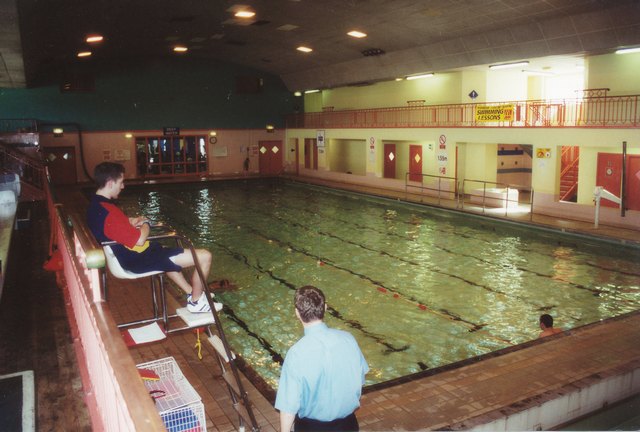 The Pool
Image courtesy of Bourne Hall Museum
 The Fitness Centre
Image courtesy of Bourne Hall Museum
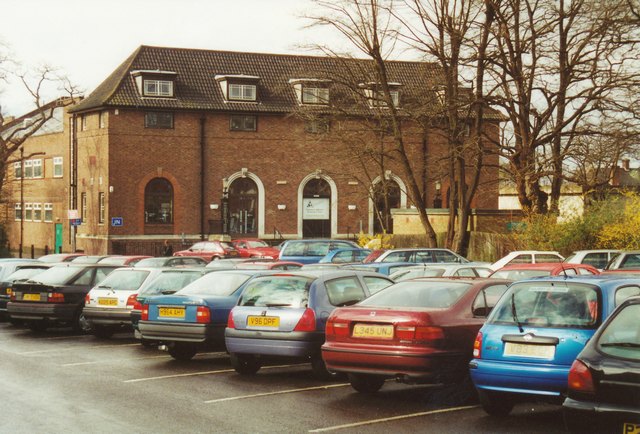
The Main Building
Image courtesy of Bourne Hall Museum
Thanks to:
Peter Reed, Webmaster, Epsom and Ewell History Explorer
Jeremy Harte, Curator, Bourne Hall Museum
Hazel Ballan, Volunteer, Epsom and Ewell History Explorer
The Baths are also referred to in John Sheen’s memoirs on this site, ‘Epsom, A Prosperous Town’.
Nick Winfield
November 2014
ADDENDUM
GYMNASTICS AT THE BATHS
In November 2021 Simon Gale told us about a great newspaper photo he saw on Facebook of the 1963 Great Britain vs Hungary Gymnastic games held in the Baths Hall.
 The Great Britain vs Hungary Gymnastic Games 16 November 1963
Original Source: Not Known. Last known source: Facebook
While researching this image we came across the interesting website gymnasticshistory.co.uk who have kindly supplied the following images taken at the same games:
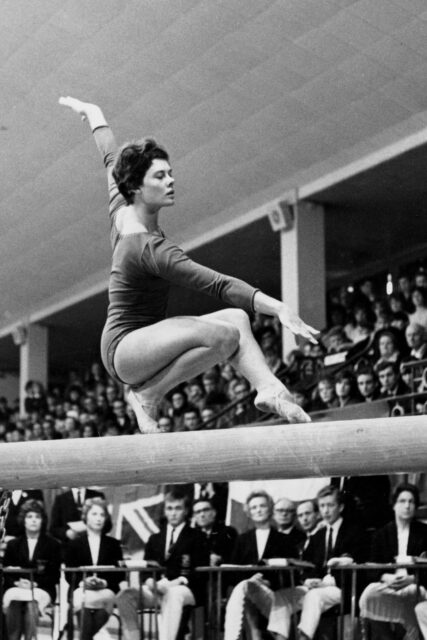 Monica Rutherford on beam
1963 GB vs Hungary (Alan Burrows)
Image courtesy of gymnasticshistory.co.uk
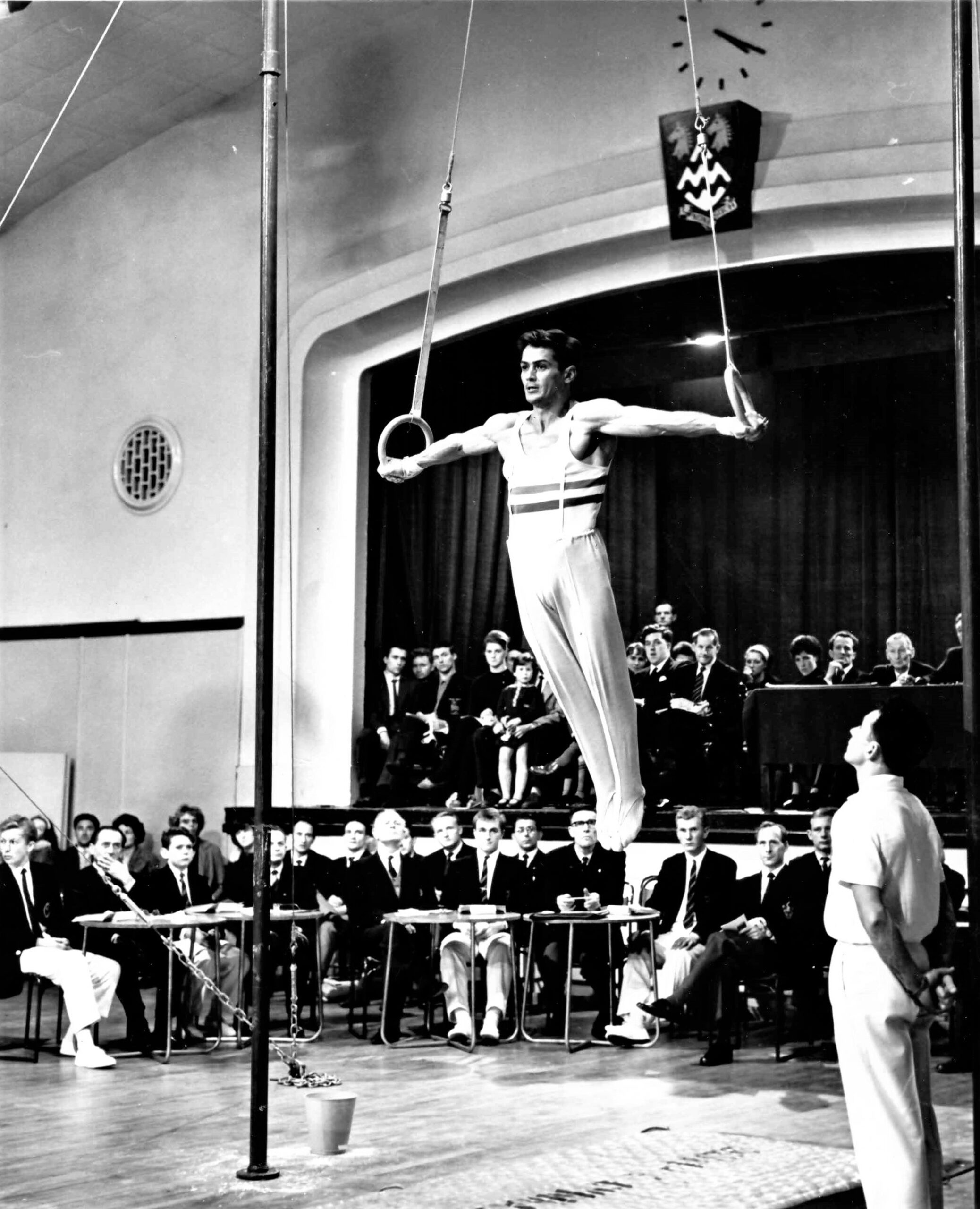 Lajos Varga on rings
1963 GB vs Hungary (London Press photo)
Image courtesy of gymnasticshistory.co.uk
We then found this British Pathé clip: